

From our research, our team of financial experts estimates that it takes two weeks to two months on average to get either a home equity loan (HEL) or home equity line of credit (HELOC), depending on the application length, lender processing time, your financial history, how organized your documents are, and the appraisal process.
If time is of the essence, top-rated HELOC lenders are able to release funds in as little as three to five days.
| Company | Funding Time | Product | Rating (0-5) |
|---|---|---|---|

|
As little as 5 days | HELOC |
|

|
As little as 3 days | HELOC |
|
Terms & Disclosures
All loans are subject to credit approval, membership and loan program requirements. Not all applicants qualify for the lowest rates and may be offered credit at higher rates or with different terms. Hazard insurance and, if applicable, flood insurance is required. Borrowing limits apply based on your home’s value. Home loans are not available in Texas. Conditions and restrictions may apply. Rates, loan programs, terms, and conditions are subject to change without notice. [1] APR = Annual Percentage Rate. The introductory APR is fixed for one year (twelve months). After one year, the APR is variable based on the U.S. Prime Rate as published in the Wall Street Journal, plus a margin. To obtain an introductory rate, borrower(s) must meet credit and loan program requirements, including, but not limited to: (1) maximum Combined Loan-to-Value (CLTV) of 75%; (2) minimum VantageScore 4.0 credit score of 720; (3) an initial draw of at least $25,000 is taken at account opening and the balance must be maintained for at least 12 consecutive months; (4) automatic payments from a FourLeaf personal savings or checking account for the monthly HELOC payments; and (5) borrower must not have had a previous introductory rate for a FourLeaf HELOC within the past five years. Failure to meet the introductory APR conditions may result in the loss of the introductory APR, meaning the APR will change to the standard APR and will be subject to those conditions. Loan amounts over $500,000 are not available for the introductory rate. [2] The standard APR is variable based on the U.S. Prime Rate as published in the Wall Street Journal, plus a margin (if applicable) and is subject to increase after consummation. The current standard APR is as low as 7.00% as of 10/7/2026. Not all applicants will qualify for the lowest rate and may be offered credit at higher rates and other terms based on creditworthiness. The minimum floor APR is 3.25%. HELOC rates may not exceed the maximum legal limit for Federal credit unions (currently 18%). The Prime Rate as of 10/7/2026 = 7.00%. Rates shown are based on a borrower’s primary residence, a maximum CLTV of 65%, a minimum initial draw of $25,000 taken at HELOC account opening†, and automatic payments‡ made from a FourLeaf personal savings or checking account. For Closing costs, see [3] below. [3] Closing costs for the first $500,000 will be paid by FourLeaf but must be repaid by the borrower(s) if the HELOC is closed within first 36 months of account opening. These fees generally range between $500.00 and $15,000.00 depending on the line amount, property value, location, and/or property type. Line amounts over $500,000 may be available on a case-by-case basis to qualified applicants, are not eligible for the discounted introductory rate at any time, and the borrower(s) will be responsible for mortgage-related taxes and title insurance costs on the line amount over $500,000 (up to the approved credit limit). The total third party fees generally range between $500.00 and $60,000.00 depending on the line amount, property value, location, and/or property type. Property insurance (including flood insurance, if applicable) is required. |
Varies, typically longer | HELOC |
Terms & Disclosures
All loans are subject to credit approval, membership and loan program requirements. Not all applicants qualify for the lowest rates and may be offered credit at higher rates or with different terms. Hazard insurance and, if applicable, flood insurance is required. Borrowing limits apply based on your home’s value. Home loans are not available in Texas. Conditions and restrictions may apply. Rates, loan programs, terms, and conditions are subject to change without notice. [1] APR = Annual Percentage Rate. The introductory APR is fixed for one year (twelve months). After one year, the APR is variable based on the U.S. Prime Rate as published in the Wall Street Journal, plus a margin. To obtain an introductory rate, borrower(s) must meet credit and loan program requirements, including, but not limited to: (1) maximum Combined Loan-to-Value (CLTV) of 75%; (2) minimum VantageScore 4.0 credit score of 720; (3) an initial draw of at least $25,000 is taken at account opening and the balance must be maintained for at least 12 consecutive months; (4) automatic payments from a FourLeaf personal savings or checking account for the monthly HELOC payments; and (5) borrower must not have had a previous introductory rate for a FourLeaf HELOC within the past five years. Failure to meet the introductory APR conditions may result in the loss of the introductory APR, meaning the APR will change to the standard APR and will be subject to those conditions. Loan amounts over $500,000 are not available for the introductory rate. [2] The standard APR is variable based on the U.S. Prime Rate as published in the Wall Street Journal, plus a margin (if applicable) and is subject to increase after consummation. The current standard APR is as low as 7.00% as of 10/7/2026. Not all applicants will qualify for the lowest rate and may be offered credit at higher rates and other terms based on creditworthiness. The minimum floor APR is 3.25%. HELOC rates may not exceed the maximum legal limit for Federal credit unions (currently 18%). The Prime Rate as of 10/7/2026 = 7.00%. Rates shown are based on a borrower’s primary residence, a maximum CLTV of 65%, a minimum initial draw of $25,000 taken at HELOC account opening†, and automatic payments‡ made from a FourLeaf personal savings or checking account. For Closing costs, see [3] below. [3] Closing costs for the first $500,000 will be paid by FourLeaf but must be repaid by the borrower(s) if the HELOC is closed within first 36 months of account opening. These fees generally range between $500.00 and $15,000.00 depending on the line amount, property value, location, and/or property type. Line amounts over $500,000 may be available on a case-by-case basis to qualified applicants, are not eligible for the discounted introductory rate at any time, and the borrower(s) will be responsible for mortgage-related taxes and title insurance costs on the line amount over $500,000 (up to the approved credit limit). The total third party fees generally range between $500.00 and $60,000.00 depending on the line amount, property value, location, and/or property type. Property insurance (including flood insurance, if applicable) is required. |
Table of Contents
- How long does the HELOC or home equity loan application process take?
- How long does the approval process take?
- How long does the funding process take?
- What happens at closing for a home equity loan or HELOC?
- HELOC and home equity loan closing documents
- FAQs for how long it takes to get a home equity loan or a home equity line of credit
How long does the HELOC or home equity loan application process take?
Submitting a HELOC or home equity loan application typically takes under 15 minutes, with online pre-approval taking less than 15 minutes if financial documents are organized. Processing and initial lender review generally wrap up within 24 to 48 hours.
The process is similar for home equity loans and HELOCs. Here’s a quick rundown of the typical steps:
- Preapproval: Getting preapproved or prequalified for a home equity loan or HELOC is not mandatory, but knowing whether and for how much you’re likely to be approved is helpful. Online preapproval is often quick, taking less than 10 minutes.
- Choose a lender: Shopping around is important to find the best home equity or HELOC terms. If you’re preapproved, you may already have rate quotes to work with. If not, it’s wise to check rates and terms with several lenders to make a final decision. You might spend a few hours to several weeks looking for the right lender. Consider starting with your current mortgage lender as a baseline.
- Apply: Once you select a lender, you can submit your application. This step can take an hour or more, depending on how organized you are and what information you need to complete the application. Many lenders allow you to submit your application and upload supporting documents online to save time.
- If you need to go to a branch to apply for a home equity loan or HELOC, you may need to book an appointment with a loan officer beforehand.
Information your HELOC or home equity home lender needs may include:
- Your name
- Birthdate
- Social Security number
- Phone number and email address
- Property address
- Property type and age
- Estimated value
- Amount owed on your mortgage
- Amount of equity you’d like to borrow
- Proof of income
You may need to upload copies of your pay stubs, bank account statements, or tax forms when you submit your application. W-2 employees often have an easier time proving their income, while self-employed applicants may have to take additional steps to justify their income and payment ability.
The lender will also perform a hard credit check.
Every lender is different in terms of how long it takes to get a home equity loan or HELOC. We’ve researched typical timelines to expect when applying with top lenders. Keep in mind these are estimates, and actual application times will vary.
| Lender | Product | Application time |
| Figure | HELOC | 5 minutes |
| Aven | HELOC | 5-15 minutes |
| FourLeaf FCU | HELOC | 10 minutes |
Read more HELOC vs. home equity loan
How long does the approval process take?
Applying for a home equity loan or HELOC may take just a few minutes. Approval can take weeks because the lender must verify your personal and financial information, as well as certain details about your home.
Two important steps are involved in the approval stage:
- Appraisal: If you’re getting a home equity loan or HELOC, the lender needs to know how much equity you have. That requires an appraisal, which may be acquired in person or digitally using an automated valuation model (AVM). A digital appraisal may shave time off the application process because you don’t have to wait for a spot to open up in a professional appraiser’s schedule.
- Underwriting: Once the appraisal is complete, the lender can proceed to the underwriting stage. This is where the lender finalizes the loan terms and verifies your information, including your credit scores and income. Underwriting is often the most time-consuming step in the application process and may take several weeks.
During underwriting, your lender might request additional documentation to verify your home ownership, income, assets, and debts. It may also perform a title search to ensure no outstanding liens against the property.
Here are estimates of how long it takes to get approved for a home equity loan or HELOC with five lenders.
| Lender | Product | Approval time |
| Figure | HELOC | 5 minutes |
| Aven | HELOC | 15 minutes |
| Bethpage FCU | HELOC | 1 – 2 days |
How long does the funding process take?
Once approved for a home equity loan or line of credit, you need to sign off on the loan documents at closing, which can take an hour or two. You’ll often sign in person with the lender, but remote closings are more common now, especially with online lenders.
Once the paperwork is signed, the lender will arrange to pay the home equity loan proceeds or set up access to your HELOC.
Once your loan is approved and closing documents are signed, funding typically takes 3 to 5 business days. By federal law (Truth in Lending Act), HELOCs and home equity loans secured by a primary residence carry a mandatory 3-business-day Right of Rescission period before funds can be disbursed. During this cooling-off window, you have until midnight on the third business day to cancel the agreement without financial penalty.
Note: The 3-day clock counts business days (including Saturdays, but excluding Sundays and federal public holiday), and does not apply to second homes or investment properties.
When time is critical, working with lenders that leverage AVM technology can yield a faster HELOC than standard appraisal methods.
What happens at closing for a home equity loan or HELOC?
Closing a HELOC typically takes two weeks to two months from application to funding through a traditional lender. However, online fintech lenders using AVMs and digital notarization can close and fund in as little as three to seven business days after your application has been approved.
HELOC closing steps
The closing process for a HELOC is similar to a home equity loan. The main difference is in how funds are disbursed.
1. Application and approval
As with a home equity loan, you’ll submit an application and provide financial documentation, including proof of income, credit history, and details about your home’s equity.
2. Home valuation
Lenders require a home appraisal to assess your property’s market value. This can be done through a traditional appraisal, a drive-by inspection, or AVM tools.
3. Loan documents prepared
Once your application is approved, the lender will finalize the loan terms and prepare your HELOC agreement. This includes details about your draw period, repayment terms, and interest rate structure.
4. Closing and funding
- Access your credit line: Unlike a home equity loan, HELOC funds are not deposited into your account. Instead, you’ll access the funds as needed during the draw period, typically via checks, a debit card, or online transfers.
- Sign the paperwork: Like a home equity loan, you’ll sign the documents in person or remotely with a notary.
- Pay closing costs: Similar fees apply, such as appraisal and document preparation fees.
Home equity loan closing process
The home equity loan closing process is usually straightforward and faster than a mortgage closing. Here’s what to expect.
How long does a home equity loan take to close?
For most borrowers, the home equity loan process takes two to six weeks from application to funding.
Process steps
1. Application
The lender begins by verifying your application and financial information. This includes confirming your income, credit score, employment, and mortgage details to determine your eligibility and the loan terms.
Prepare documents, including recent pay stubs, tax returns, and proof of homeowners insurance, in advance to avoid delays.
2. Appraisal
A home appraisal determines your home’s current value and how much equity you can borrow. Depending on the lender, this appraisal might be conducted digitally via an AVM or in person by a licensed appraiser.
3. Loan documents prepared
Once your application is approved and the appraisal is complete, the lender will prepare the final loan documents. These outline your loan terms, repayment schedule, and any associated costs.
4. Closing and funding
Now you’re ready to close on your loan and get your funds. To do this, you:
- Sign the paperwork: Borrowers and co-applicants sign the loan documents, often in person or via remote closing with a notary.
- Pay closing costs: Fees such as the appraisal, origination, and title search fees are due at closing. Borrowers typically pay via wire transfer or certified check.
- Get the loan funds: After a three-day rescission period, the lender will deposit the lump sum into your designated account.
HELOC and home equity loan closing documents
When you reach the closing stage of a HELOC or home equity loan, most of the heavy lifting is already done. At this point, your role is to carefully review and sign the final loan documents.
Here are the key documents you can expect to see:
- Loan agreement or promissory note: This is the core contract outlining your interest rate, repayment terms, and any fees or penalties.
- Mortgage or deed of trust: Secures the loan using your home as collateral.
- Closing disclosure: Provides a final breakdown of your loan terms, monthly payment, and closing costs. You should review this carefully to make sure it matches what you were quoted.
- Truth in Lending (TIL) disclosure: Summarizes the total cost of borrowing, including the APR and total payments over time.
- Initial escrow statement (if applicable): Shows how much will be collected and paid for property taxes and homeowners insurance.
- Title documents and title insurance: Confirm that your property’s title is clear and protect against future ownership disputes.
Your lender or closing agent will walk you through each document before you sign. Make sure to take a few extra minutes to review the details.
FAQs for how long it takes to get a home equity loan or a home equity line of credit
Should I get a home equity loan or a HELOC?
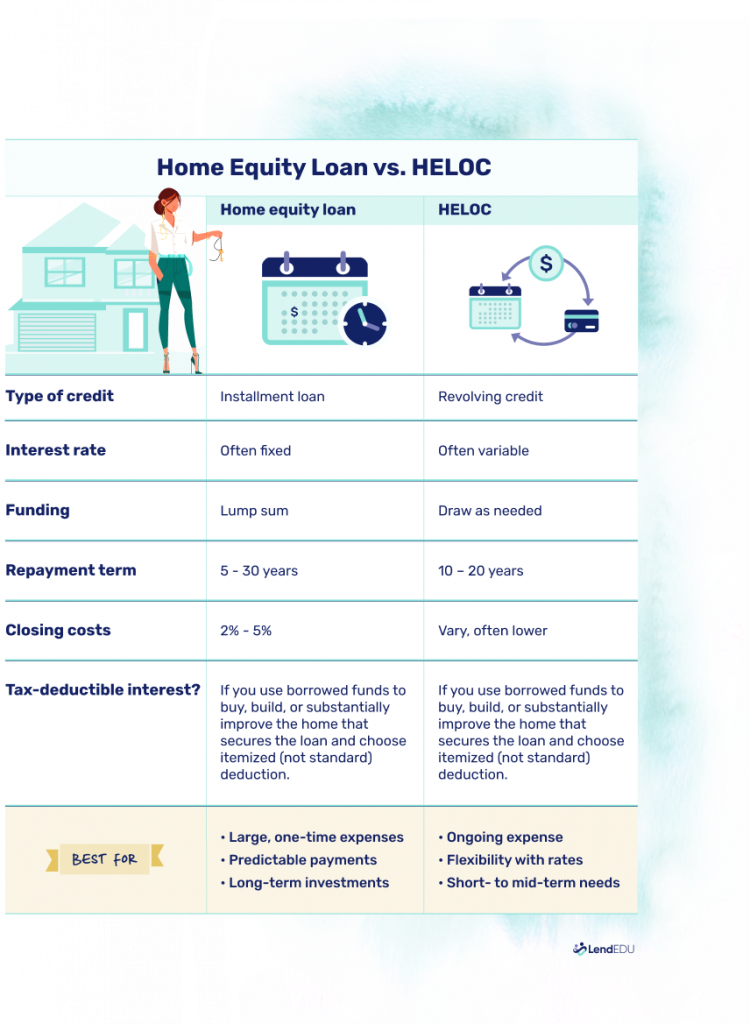
Whether a HELOC or home equity loan is best for you often depends on what you plan to use the funds for and how you prefer to repay what you borrow.
How long does it take to get a home equity loan?
Getting a home equity loan can take two weeks to two months. It’s possible to apply for a home equity loan online in minutes, with initial approval following in as little as three business days. Underwriting may take a few weeks, and closing may follow within a week or two of final approval. Funds may be disbursed anywhere from three business days to two weeks after closing.
How long does it take to get a HELOC?
On average, it takes two weeks to two months to secure a home equity line of credit (HELOC) or home equity loan, though fast-track lenders using AVMs can fund HELOCs in as little as 3 to 5 business days. To get a HELOC, you’ll need to compare lenders, submit an application, complete a property valuation or appraisal, provide supporting documents, and sign loan paperwork at closing.
What factors affect the length of the process the most?
The most significant influences on how long it takes to get a home equity loan or HELOC are often the lender you’re working with, what’s required for underwriting, and whether an in-person appraisal is needed. Not having your supporting documents prepared beforehand can also slow you down.
It may be faster to apply for a home equity loan or HELOC with the lender that holds your current mortgage because it already has your personal and financial information on file. But consider whether that makes sense if you could get a lower interest rate or pay fewer fees elsewhere. Cost may outweigh convenience.
Are there ways to speed up the process?
If you’d like to get through the home equity loan or HELOC process as soon as possible, getting preapproved and organizing your paperwork could help speed it up.
You could also save time by choosing a lender that offers a shorter processing window from application to funding. For instance, you might choose a lender that allows digital valuations versus requiring an in-person home appraisal.
What are my options if I need faster access to funds?
If you need money fast and don’t have time to wait for a home equity loan or HELOC to process, consider other borrowing options.
Cash advance apps are often the fastest way to get funds, but they only allow smaller amounts (up to $750).
If you need to borrow a larger amount, you might consider an unsecured personal loan instead. Getting same-day approval and funding in just a few business days with online personal lenders is possible. Compare rates and terms to ensure you get the best personal loan.
Can I be denied during the closing process?
It’s pretty rare for a lender to pull your loan at the closing stage—you’ve already been approved, and most of the hard work is behind you. That said, small issues can still slow things down.
For example, if you forget your ID or a co-applicant can’t make the closing appointment, you may have to reschedule. That can push your timeline back by several days—or even weeks.
The best way to avoid delays is to follow your lender’s instructions closely and speak up if something isn’t clear. As long as you stay organized and prepared, closing is usually quick and straightforward.
About our contributors
-
 Written by Rebecca Lake, CEPF®
Rebecca Lake is a certified educator in personal finance (CEPF®) and freelance writer specializing in finance.
-
 Edited by Kristen Barrett, MAT
Kristen Barrett is a managing editor at LendEDU. She lives in Cincinnati, Ohio, with her wife and their pack of senior rescue dogs. She has edited and written personal finance content since 2015.