


Our take: Aven offers two ways to access your home equity: the Aven Home Equity Cash HELOC and the Aven Home Equity Visa Card. While the card provides flexible access to funds with HELOC-like rates, we generally recommend Aven Home Equity Cash because its fixed rates, predictable payments, and structured repayment make it the better option for most homeowners borrowing against their equity.
Home Equity Line of Credit (HELOC)
- Offers lowest rate guarantee
- Approval in as little as 15 minutes
- Excellent customer reviews from more than 6,000 customers
- 100% digital application process
- Increases the credit line for select customers
- Automated appraisals
- High maximum loan-to-value ratio (LTV)
- Three-day funding after signing
- Fixed interest rates
- Check your rate with no credit impact
- Short draw period
- Full HELOC must be drawn at origination
- First-draw fee of 4.90%
- Only available in 32 states
| Rates (APR) | 6.99% – 15.49% |
| Loan amounts | Varies by state and other criteria |
| Repayment terms | 5, 10, 15, or 30 years |
| Min. credit score | 640 (but 720+ recommended) |
| Funding time | As little as 3 days after signing |
Home Equity-Backed Credit Card
- Easy online process
- Lower rates than typical credit cards
- High credit limits
- No appraisal or origination fees
- You only borrow what you need
- Unlimited 2% cash back
- 2.5% fees on cash and balance transfers
- Risk of overspending due to card convenience
- Credit limit may be reduced if inactive
- Daily and monthly transfer limits
| Rates (APR) | 7.99% – 15.49% (variable) |
| Limit amounts | Up to $400,000 |
| Annual fee | $0 |
Aven is a fintech lender that focuses on faster, fully digital ways for homeowners to access their equity. It offers two main products: the Aven Home Equity Cash HELOC, which functions like a modern fixed-rate home equity line of credit, and the Aven Home Equity Visa Card, a credit card secured by your home equity. Both products aim to streamline the borrowing process with automated appraisals, online applications, and approvals that can happen in minutes instead of weeks.
While both options provide quick access to home equity, Aven Home Equity Cash is the better fit for most borrowers. Its fixed-rate structure and predictable repayment plans make it more suitable for larger or longer-term borrowing needs.
The Aven card can still be useful for short-term flexibility or everyday spending with lower-than-typical credit card rates, but the convenience of a swipeable credit line tied to your home also requires more discipline. For most homeowners, the stability and clearer repayment structure of Aven’s HELOC make it the safer and more practical choice.
Aven Home Equity Cash HELOC
Rates, terms, and cost example
Aven’s Home Equity Cash HELOC lets you tap your equity as cash with a streamlined, 100% online process and predictable fixed payments. You check your offer online, close with a remote notary, and can get funding in as little as three business days.
When you draw from your HELOC, Aven converts that amount into a fixed-rate plan with fixed monthly payments for a set term. If you take additional draws later, those new amounts can come with their own fixed rates based on your terms and credit profile at that time. That structure gives you predictability on each chunk you borrow, even though you’re still working from a revolving credit line.
Aven does not charge application or appraisal fees, but it does charge a 4.90% first-draw fee at closing. This functions like an origination fee on the full amount you’re required to draw initially.
Here’s a snapshot of Aven’s key HELOC terms:
| Terms | Details |
| Rates (APR) | 6.99% – 15.49% fixed |
| HELOC amounts | Varies by state and other criteria |
| Minimum draw amount | Full HELOC amount |
| Draw period | 5 years |
| Term lengths | 5, 10, 15, or 30 years |
| Origination (first-draw) fee | 4.90% |
| Application fee | $0 |
| Unique features | Automated appraisals; lowest rate guarantee; debt protection program; credit line increases for select customers |
Example: Costs and fees of Aven’s HELOC
You won’t pay many fees with Aven, but its HELOC isn’t entirely fee-free. While Aven doesn’t charge application or appraisal fees, it does levy a 4.90% first-draw fee, which is essentially an origination fee. Aven also assesses a $29 late fee on its home equity card, though it’s unclear if this applies to Aven Home Equity Cash.
However, fees are only one piece of the HELOC affordability puzzle. These fees work in tandem with your interest rate to create your annual percentage rate (APR). Your APR reflects the true premium you pay for your credit line, so locking in the lowest possible APR is imperative.
To better illustrate how APR can influence your borrowing cost, let’s say that you withdraw $50,000 from your HELOC at an 11% APR. Here’s how much your HELOC would cost over time:
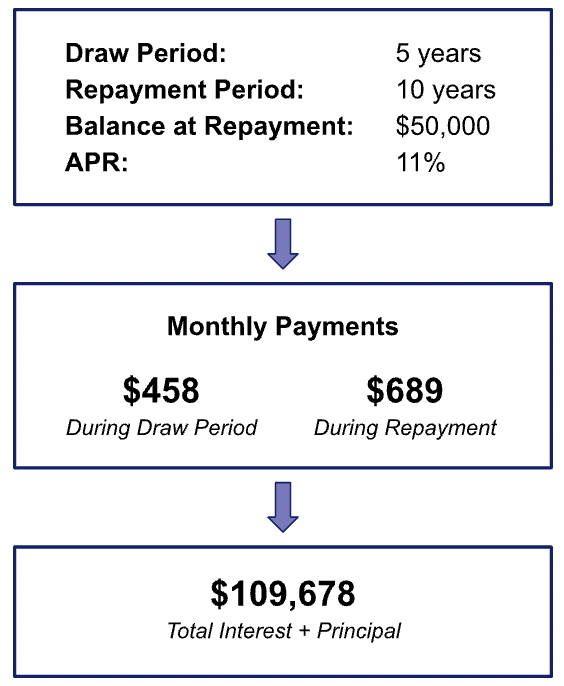
What started as a $50,000 balance ballooned into a six-figure price tag because of your 11% APR. But what if you held out for a better rate and qualified for a 9% APR instead? How might that change your payments and overall borrowing cost?
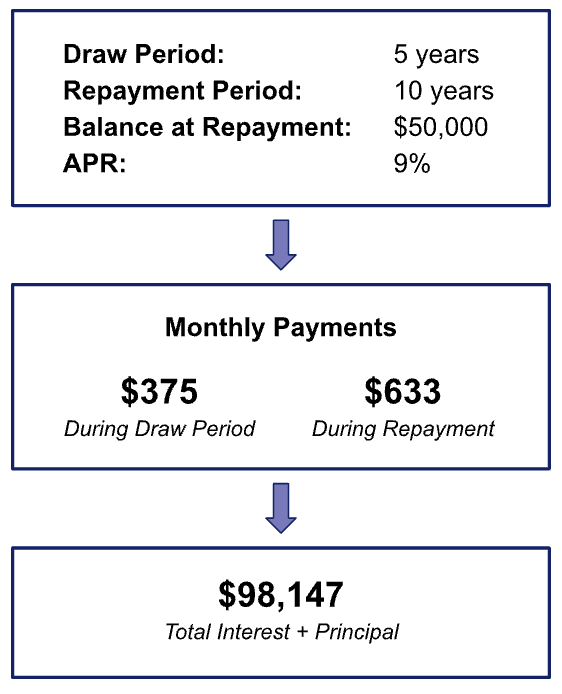
If we look just at your monthly payments, particularly your payments once your draw period ends, it’s easy to miss how influential your APR really is.
However, we can see your APR’s cumulative impact when we zoom out. Not only are your monthly payments more affordable at the lower rate, but you’ve also saved $11,531 over the life of your HELOC.
Once you understand the basic terms and how your costs can vary based on your APR, it helps to look at how Aven’s process works in practice. Below are the core features that shape the Aven Home Equity Cash experience from application to funding to repayment.
Key features
100% online application
Aven’s entire process is digital—from your initial inquiry to your final signing—so you can complete your HELOC from your phone or computer without scheduling in-person appointments.
Instant prequalification
Aven begins every application with a quick screening. You’ll know within seconds whether you’re preapproved, and many applicants can move from application to closing in about 15 minutes.
Automatic income verification
Aven uses connected data sources to verify most applicants’ income automatically. Some borrowers may be asked to link a bank account or upload documents like W-2s or 1099s, but the process is typically fast and seamless.
Minimal insurance requirements
Aven generally doesn’t require proof of homeowners’ insurance unless the property is in a flood zone or the credit line exceeds $100,000, reducing the amount of paperwork you need to provide.
Digital appraisals and notarization
The entire process can be completed from your phone or computer. Aven uses automated valuation models (AVMs) to estimate your home’s value using tax data and recent sales, and you’ll sign closing documents with an online notary—no in-person appointments or paper forms required.
Lowest rate guarantee
Aven offers a lowest-rate guarantee, giving borrowers added confidence that the rate they receive is competitive for their financial profile.
Funding in as little as 3 days
After closing and the mandatory three-day waiting period required for HELOCs, Aven releases your funds. Many applicants access their line within just a few business days.
No redraw fees
You can pull from your HELOC as often as you need during the five-year draw period without paying redraw fees. Keep in mind that Aven requires you to draw the full amount at origination, so you’ll need to pay down part of your balance before you can withdraw additional funds.
Automatic credit line increases
If you make on-time payments or your home equity increases, Aven may automatically invite you to raise your credit limit—no separate application required.
Flexible repayment terms
Once the draw period ends, you can choose a repayment term between five and 30 years, giving you the ability to tailor your monthly payments to your budget.
No prepayment fees
You can make extra payments or pay off your HELOC early without penalty.
Homeowner protection guarantee
Aven advertises a Foreclosure Protection Guarantee and offers hardship flexibility for borrowers facing financial difficulty.
HELOC refinancing
If you already have a second-lien product—like a HELOC or home equity loan—you can refinance it into an Aven HELOC with no origination or transfer fees.
Eligibility requirements
Qualifying for an Aven HELOC comes down to three main factors: your credit profile, your available equity, and the state you live in. Like most home equity lenders, Aven wants to see that you can manage additional debt and that your home has enough value to support the credit line you’re requesting.
Aven also allows joint applications, which can be helpful if a co-borrower—such as a spouse—has a stronger credit profile.
Below is a closer look at Aven’s eligibility and residency requirements:
| Requirements | Details |
| Eligible properties | Primary residences and investment properties |
| State of residence | Alabama, Alaska, Arizona, Arkansas, California, Colorado, Florida, Iowa, Illinois, Kansas, Kentucky, Louisiana, Maine, Michigan, Minnesota, Mississippi, Nebraska, New Hampshire, New Jersey, New Mexico, North Carolina, North Dakota, Ohio, Oklahoma, Oregon, Pennsylvania, South Dakota, Tennessee, Utah, Virginia, Wisconsin, Wyoming |
| Maximum loan-to-value (LTV) | 89% |
| Maximum debt-to-income | Not disclosed |
| Minimum credit score | 640 |
| Minimum income | Not disclosed |
Recommended credit score: 720+
Although Aven lists 640 as its minimum credit score, applicants with scores below 720 may have a much lower chance of approval. In practice, borrowers with scores of 720 or higher tend to see stronger approval odds, better rates, and higher credit limits. If your score is below that threshold, you may want to consider alternatives before applying.
LTV up to 89%
Aven’s underwriting also weighs your home’s value and available equity. This is where your loan-to-value ratio (LTV) comes in. LTV measures how much you owe on your home compared to what it’s worth.
Aven allows a combined LTV of up to 89%, meaning your mortgage plus your new HELOC can’t exceed 89% of your home’s value. Lower home values or lower equity levels may result in smaller credit limits or higher rates.
Here’s an example of how LTV affects how much you may be able to borrow:
LTV example
Say, for instance, that you owe $150,000 on a $300,000 home. Here’s how Aven might calculate how much you can borrow with a HELOC in light of its LTV threshold:

But what if Aven determined your home value to be slightly higher? Take a look below to see how much more you could borrow if your home appraised at $325,000 instead:

In our first example, $117,000 was the largest HELOC you could get without surpassing the 89% cap. With the increased property value in our second example, your potential HELOC limit went up by $22,250.
Before you rush to remodel your kitchen, we should mention that virtual appraisals don’t always capture improvements like these. That’s because these appraisals rely on tax data and recent selling prices of nearby homes, not necessarily a physical examination of your property.
Rather than investing in renovations you weren’t otherwise planning, you may see better results—both to your HELOC limit and your long-term financial position—by reducing your mortgage balance instead.
No property-type restrictions
Aven is flexible when it comes to property type. It considers primary residences, second homes, investment properties, new construction, and even homes held in a trust—something not all HELOC lenders allow.
Pros and cons
Pros
-
High maximum LTV
Aven’s 89% LTV threshold makes its HELOC more accessible to more homeowners. It also means you could open a larger HELOC than you’d qualify for elsewhere.
-
Fixed rates
With Aven, your HELOC rate will never change, so you’ll know what to expect month after month.
-
Few fees
Unlike some of its competitors, Aven doesn’t charge application, appraisal, or notary fees. You won’t pay an annual fee, either.
-
Customizable repayment options
Aven offers four different repayment periods, and you can choose the term that best suits your finances.
-
Completely virtual application and appraisal
You’ll forego the time and hassle of scheduling a traditional appraisal with Aven. You could apply and get approved in as little as 15 minutes.
-
Unique borrower benefits
From its lowest rate guarantee to its debt protection program, Aven offers borrowers unique benefits you can’t find with other lenders.
Cons
-
Virtual appraisals aren’t always accurate
While convenient, automated appraisals aren’t as thorough as in-person valuations. Because it can’t catch everything, Aven’s system might undervalue your home.
-
Not available everywhere
Aven only lends in 32 states, rendering many homeowners ineligible for its HELOC.
-
Limited draw period
Aven’s draw period is considerably shorter than what you might get with another lender, which is only five years.
-
Full amount is drawn at origination
Aven requires borrowers to draw their entire HELOC amount initially, meaning you must repay some of the balance within that five-year draw period to redraw funds as needed.
-
No introductory rates or rate discounts
Some HELOC companies offer perks like a reduced rate for your first 12 months or when you sign up for autopay. Aven, however, isn’t one of them.
Aven Home Equity Visa Card
How does the Aven card work?
The Aven Home Equity Visa Card works like a credit card that is secured by your home equity. It functions similarly to a HELOC because you only borrow what you spend, but it also gives you the everyday convenience of paying with a card. This setup allows Aven to offer lower interest rates than typical credit cards and a faster approval process than most home equity products.
Rates and terms
Aven offers variable interest rates between 7.99% and 15.49%, depending on your credit profile, income, property value, and state of residence. Borrowers who enroll in autopay can receive a 0.25% rate discount.
Aven also offers a fixed-rate option through its Aven Simple Loan, which lets qualifying borrowers convert balance transfers or cash advances into predictable monthly payments.
Here is a summary of the card’s core terms:
| Term | Details |
| APR | 7.99% and 15.49% (variable) |
| Fixed-rate option | Available through Aven Simple Loan for qualifying borrowers |
| Terms | Account renews annually up to 15 years |
| Credit limit | Up to $400,000 |
| Annual fee | $0 |
| Appraisal | Not required; uses automated valuation models |
| Closing costs | None |
| Funding time | As little as 3 days after approval |
| Right of rescission | Available, similar to other home equity products |
Fees
Aven has fewer upfront costs than traditional HELOCs. There are no appraisal fees, origination fees, or closing costs. However, certain transactions have associated fees.
| Fee type | Cost |
| Origination fee | $0 |
| Cash transfer to bank | 2.5% of amount transferred |
| Balance transfer fee | 2.5% of amount transferred |
| Annual fee | $0 |
| Late payment fee | $29 |
Key features
Prequalify in minutes
Aven uses automated underwriting, so you can see your potential rate and credit limit in a few minutes. Prequalification uses a soft credit check, so it does not affect your credit score.
100% online application and approval
If you move forward after prequalifying, you complete the entire process online. Aven verifies income through connected accounts or documents. You sign your closing documents with a notary through a short video call. Since the company uses automated valuation models, no full appraisal is required.
Credit limits up to $400,000
Depending on your credit profile and home value, Aven may approve a line as high as $400,000. Your approved amount depends on your equity and Aven’s maximum combined loan-to-value requirements.
Funding in as little as 3 days
Once your documents are notarized, Aven typically provides access to funds within about three business days.
Lowest rate guarantee
Aven advertises a lowest rate guarantee on its website. If you meet program rules and submit a qualifying offer for a lower rate from another lender, Aven may match it. Terms and eligibility apply.
Unlimited 2% cash back
The Aven card earns unlimited 2% cash back on every purchase. Rewards apply automatically and do not have spending caps.
Send cash to your bank
You can transfer funds from your Aven card to your bank account at your card’s APR. A 2.5% transfer fee applies.
Balance transfer flexibility
You can transfer high-interest credit card or personal loan balances to the Aven card and repay them at the lower Aven APR. A 2.5% fee applies for each transfer.
Homeowner protection guarantee
Aven offers a Foreclosure Protection Guarantee and flexible repayment options intended to help protect your home if you experience financial hardship.
How do you repay an Aven credit card?
Repaying an Aven Home Equity Visa Card works much like repaying a traditional credit card. Your minimum monthly payment is about 1% of your outstanding balance plus any interest and fees for the cycle. The minimum is intentionally low, which can help with flexibility, but paying only the minimum will slow your progress.
Most borrowers will want to pay more than the minimum to reduce interest costs and pay down the balance faster. Aven also offers a fixed-rate repayment option called the Aven Simple Loan. It lets you convert qualifying balance transfers or cash transfers into a set monthly payment with a defined payoff schedule.
If you use your card to transfer cash to your bank account, those amounts are added to your revolving balance unless you choose to move them into a Simple Loan. In that case, your required monthly payment may increase because you are now repaying an installment plan rather than a revolving line.
Overall, repayment on the Aven card is flexible. You can pay more when you want to accelerate your payoff or rely on the lower minimum during months when cash flow is tight. The Simple Loan option adds a way to create predictable payments for larger balances.
Aven card requirements
Aven’s fully automated system evaluates your eligibility for the Aven card based on the following factors:
- You should own your home and have substantial equity.
- You should have enough income to support your monthly repayment amount.
- You must meet their credit score requirements, debt-to-income, and property value.
Aven doesn’t disclose many of the specific eligibility details for its credit card, but here’s what we’ve found:
| Requirement | Details |
| Properties | Primary residences, secondary homes, investment properties (additional requirements apply for the latter two) |
| State of residence | Licensed in 45 states and Washington D.C. |
| Maximum loan-to-value | 89% of primary residences |
| Maximum debt-to-income | Not disclosed |
| Minimum credit score | 640 for primary residences |
| Minimum income | Not disclosed |
| Age and identification | Must be 18 years of age or older and possess acceptable government-issued identification |
You must also provide proof of insurance for credit lines above $100,000. You must also add Aven/Coastal Community Bank as a beneficiary to that insurance policy.
You can contact Aven for more information or see whether you prequalify on its website, but this table should give you a solid starting point.
How does your home’s value affect your terms?
Aven allows a maximum combined loan-to-value (CLTV) ratio of 89% on primary residences for its credit card. This means that your loan amount combined with what you owe on your mortgage can’t exceed 89% of your home’s value.
For example, if you have a home worth $500,000, 89% of that is $445,000. If you have a mortgage for $300,000, that’s a potential $145,000 line of credit.
A higher value on the home could mean a higher loan amount or a lower combined loan-to-value (CLTV) ratio. A lower CLTV ratio could mean a better interest rate. But your income and debt levels also play a role in qualifying you for the card and the terms you get.
Pros and cons
Aven’s credit card is unique, so it’s essential to weigh the pros and cons to determine if it’s the right fit for you. Here’s a rundown of its strengths and weaknesses.
Pros
-
Easy process
The technology Aven uses speeds the application process along. You may be able to access a large credit line with favorable interest rates within a week.
-
Low interest rates
The APR on the Aven card can be around half of the APR on other credit cards.
-
High credit limit
In many states, you can get a credit line up to $250,000, which offers substantial borrowing power.
-
No appraisal required
Aven’s automated system means you skip the traditional appraisal, speeding up the application process.
-
No origination fees
Traditional HELOCs often come with origination fees. With Aven, you avoid that upfront cost.
-
Up to 2% cash back
By using your Aven credit card, you earn 2% cashback on your spending.
-
You only borrow what you need
Because the credit line is revolving, you only take on debt when you actually spend. This can be more cost-effective than a lump-sum home equity loan.
Cons
-
High qualifications for low rates
For Aven’s most favorable rates, you’ll need a high credit score and substantial home equity.
-
Fees for cash and balance transfers
Aven charges a 2.5% fee on cash transfers to your bank and on balance transfers. These costs are lower than many traditional credit card fees but higher than what you would pay with a standard HELOC, where drawing funds typically does not cost extra.
-
Aven can reduce your credit limit
If you’re not using your account, Aven reserves the right to reduce the credit line you can access on each account anniversary.
-
Daily and monthly withdrawal limits
Users report daily and monthly limits of $15,000 and $30,000, making it difficult to make larger purchases. CashOuts have a higher daily $50,000 withdrawal limit, but they’re still subject to the 2.5% fee.
-
Required initial draw for credit lines over $100,000
If your credit line is over $100,000, you need to draw at least $50,000 in the first 90 days, or your credit limit will be reduced.
Is Aven a good credit card to use?
Aven can be a good option if you want lower interest rates than a typical credit card and you feel comfortable using your home equity to secure the line. It works well for homeowners who need flexible access to funds for things like home improvements or who want to consolidate higher-interest debt without going through a full HELOC process.
It may not be the best fit if you prefer an unsecured credit card or if you know you are prone to overspending when credit is easy to access. Because the card is tied to your home, disciplined use is important. The 2.5% fee on cash and balance transfers is another key factor if you plan to move money out of the card frequently.
Aven HELOC credit card vs. Aven HELOC
Aven offers two ways to access your home equity: the Aven Home Equity Visa Card and Aven Home Equity Cash, its fixed-rate HELOC. Both rely on your home equity, but they function very differently. The card focuses on fast access, flexible spending, and rewards. Aven Home Equity Cash focuses on predictable repayment and long-term borrowing power.
| Feature | Aven card | Aven Home Equity Cash |
| Collateral required | ✅ | ✅ |
| Interest rates | Variable | Fixed, with a new fixed rate assigned at each draw |
| Credit line | Up to $400,000 | Based on home value and income, up to 89% combined loan-to-value |
| Cashback rewards | Up to 2% | Not offered |
| Application | Fully automated and online | Online application with full underwriting review |
| Fees | 2.5% on cash transfers and balance transfers | No appraisal, no origination fee, no closing costs |
| Valuation | Automated valuation model | Automated valuation model |
| Repayment | Revolving, similar to a credit card | Fixed-rate repayment for each draw |
| Minimum credit score | 640 | 640 minimum listed; 720 recommended for best approval odds and rates |
Aven Home Equity Cash operates as a fully fixed-rate HELOC. Each time you draw from your line, that draw receives its own fixed rate and repayment schedule. This gives you rate stability while still allowing multiple draws over time. Combined with no appraisal fees, no origination fees, and no closing costs, it remains one of the strongest HELOC options we have reviewed.
If you want predictable repayment and the long-term stability of fixed rates, Aven Home Equity Cash is usually the better choice. If you want fast access to equity with a card you can use anywhere and a streamlined approval process, the Aven Home Equity Visa Card may be a better fit.
Aven home equity card vs. traditional credit card
The Aven Home Equity Visa Card works like a traditional credit card, but the experience is different in a few important ways. Because it is backed by your home equity, the Aven card can offer lower interest rates, a much higher credit limit, and the ability to transfer cash to your bank at the same rate.
A standard credit card does not require collateral and is easier to qualify for, but it usually comes with higher rates and lower limits. If you want everyday swipe-and-go convenience with HELOC-style pricing, the Aven card fills that gap, although it still carries fees for cash and balance transfers that traditional credit cards may or may not charge.
| Feature | Aven card | Credit card |
| Collateral? | ✅ | ✖️ |
| Interest rates | Variable | Often variable and higher |
| Credit line | Up to $250,000 | Often lower |
| Cashback rewards | Up to 2% | Varies by card |
| Application | Automated, online | Often online |
| Fees | Cash-outs and balance transfers | Varies |
| Appraisal? | Automated | No |
| Repayment | Similar to credit card | Monthly minimum |
| Credit score | 640 | Varies |
Aven HELOC alternatives
For many homeowners, Aven’s Home Equity Cash may be the clear winner, and for good reason. Still, it’s wise to consider your options before committing to a lender. Here are three of the best HELOC lenders available:

rates
loan amounts
Varies by state
$15,000 – $750,000
$10,000 – $500,000
repayment terms
5, 10, 15, or 30 years
5, 10, 15, or 30 years
5, 10, and 20 years
Aven vs. Figure
Figure is available in more states and allows loan-to-value ratios up to 95 percent. If you need a larger credit line or live in a state where Aven is not offered, Figure may be the better fit. Read more about how Aven and Figure compare.
Aven vs. FourLeaf
FourLeaf offers a 10-year draw period, and HELOC limits up to $1 million. Homeowners who want longer access to their line or significantly higher borrowing power may prefer FourLeaf over Aven.
Is Aven legit?
Yes. Aven is a legitimate lender with a strong track record of customer satisfaction. Thousands of positive Trustpilot reviews and an A+ rating from the Better Business Bureau (BBB) help reinforce its credibility.
Most of Aven’s reviews are for its equity-backed credit card rather than its traditional HELOC. Even so, these reviews offer useful insight into the company’s overall service quality, communication, and customer support. Here is how customers rate Aven:
| Source | Customer rating | Number of reviews |
| Trustpilot | 4.9/5 | 8,036 |
| Better Business Bureau | 1.1/5 | 10 |
Aven’s low star rating on the BBB website is based on only a few reviews, so it does not carry the same weight as the 6,000 plus reviews on Trustpilot. The A+ BBB rating also reflects strong business practices and responsiveness. Taken together, the high volume of positive Trustpilot feedback and the A+ accreditation indicate that Aven performs well for most customers.
Reviewers frequently mention Aven’s fast application process, clear communication, and helpful customer support team. These qualities are consistent with what you can expect from the company’s Home Equity Cash product.
No lender is perfect, and Aven is no exception. Some customers report unclear communication during the approval process, and a few have noted unexpected freezes on their HELOC card accounts. These issues appear to be isolated, but they are worth noting.
Overall, Aven’s large number of positive reviews and strong BBB standing are why we designated its HELOC as the best for customer reviews.
How to contact Aven
You may want to download Aven’s app to help manage your Aven card. This app allows you to check your balance, see your transactions, and pay your bills. You can also manage your Aven card online.
If you need to contact customer service, you have several options to get in touch:
- Email: [email protected]
- Website: Send a message via the contact form.
- Schedule a call back: Set up a time that’s convenient for you
- Call: 415-582-6613
How to apply with Aven
Apply for a Home Equity Cash HELOC
Aven’s tech-powered HELOC application process is just as innovative as its product offerings. Here’s how it works:
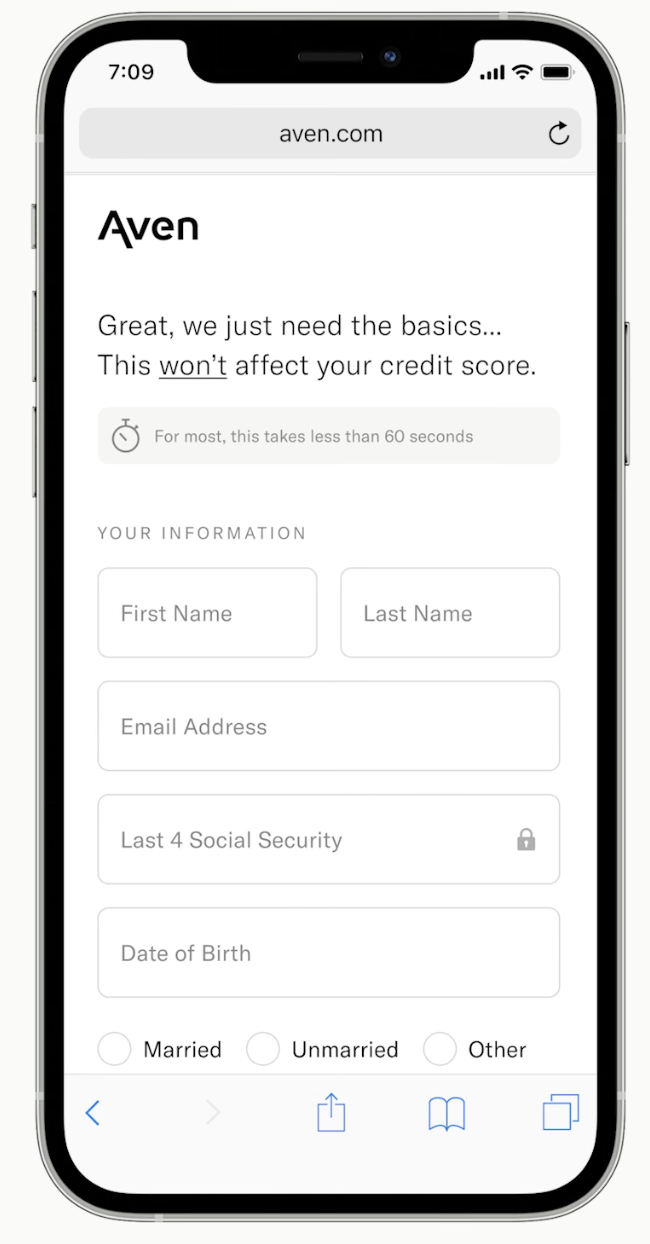
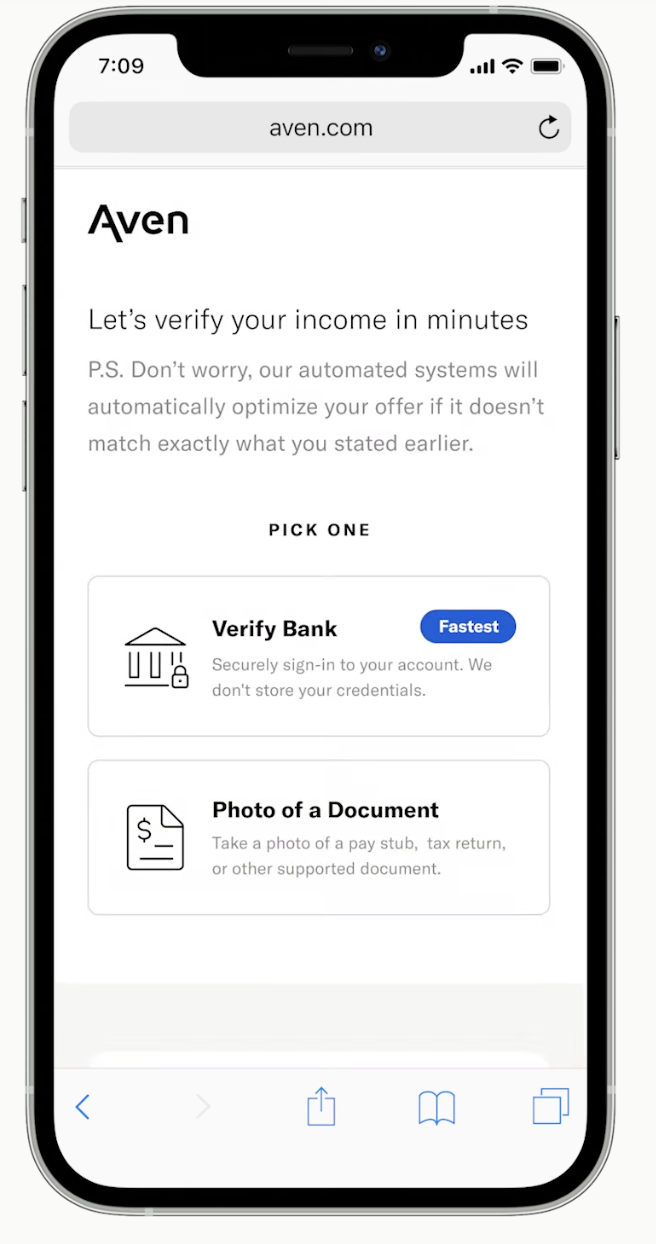
After reading your HELOC agreement, prepare to hang tight through the mandatory three-day waiting period. As soon as this window passes, Aven will fund your HELOC, and you’ll have access to your new credit line.
Apply for the home equity-backed credit card
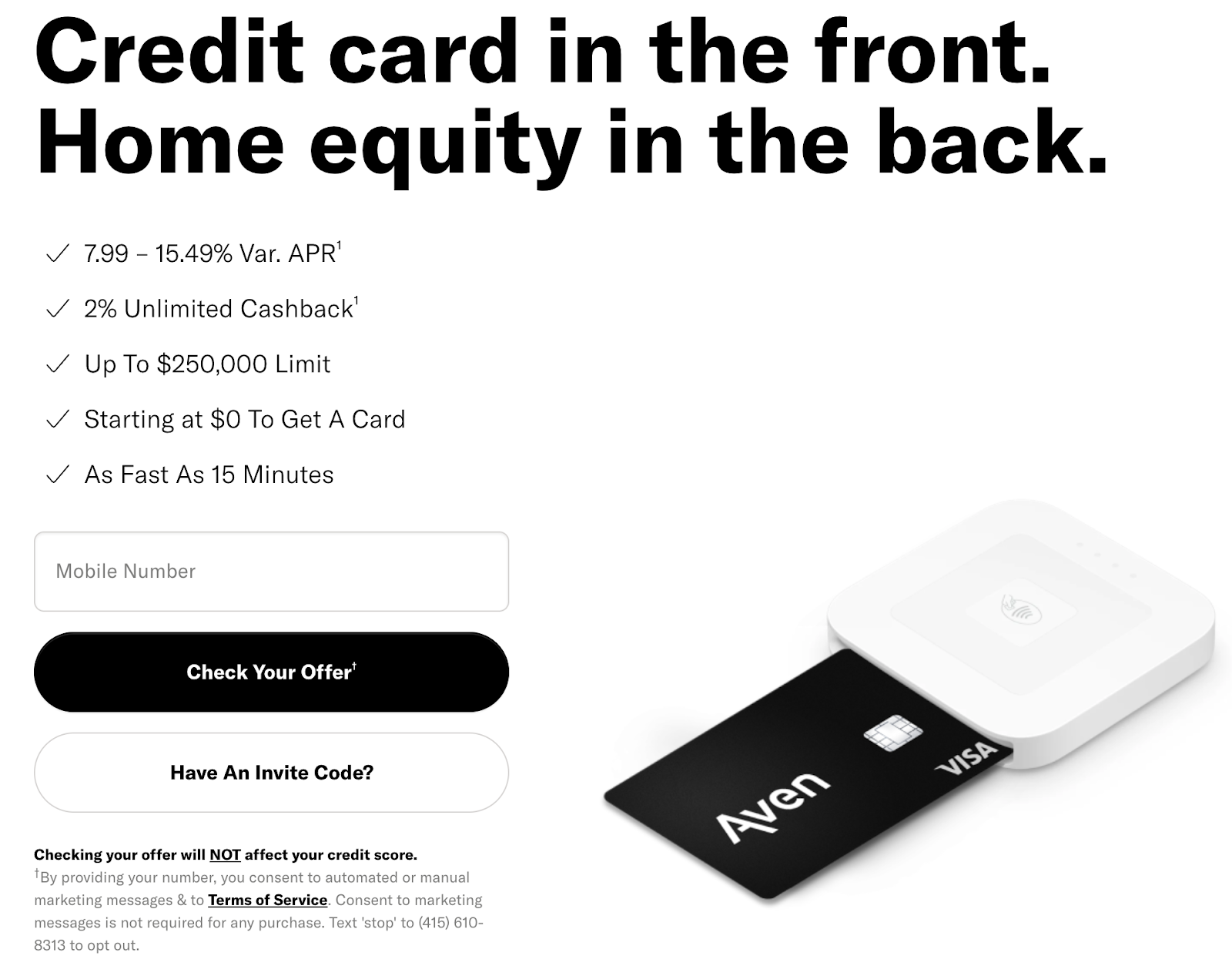
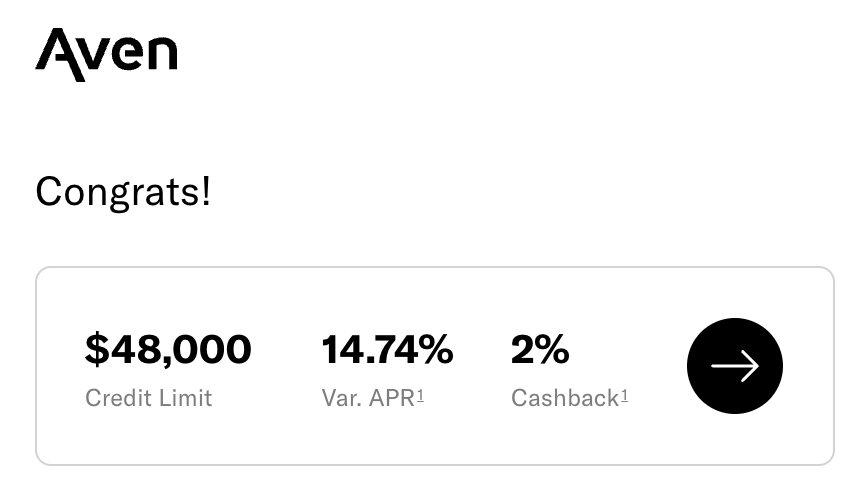
Applying for an Aven card is much faster and easier than applying for a HELOC. The card also allows you to prequalify, which allows you to check your offer without affecting your credit score.
If you do proceed, you will be subject to a hard credit check later in the process. You will also need to provide proof of income and sign in front of an online notary.
Here’s what the application looks like from start to finish.
How we rated Aven in our home equity reviews
We designed LendEDU’s editorial rating system to help readers find companies that offer the best HELOCs. Our system awards higher ratings to companies with affordable solutions, positive customer reviews, and online transparency of benefits and terms.
We compared Aven to several home equity lenders, using hundreds of data points from company websites, public disclosures, customer reviews, and direct communication with company representatives. We weighted, scored, and combined each factor to produce a final editorial rating. This rating is expressed on a scale from 1 to 5, with 5 being the highest possible score. Our take is represented in our rating, recapped below.
Related articles
About our contributors
-
 Written by Alene Laney
Alene Laney is a personal finance writer specializing in mortgages, home equity, and consumer financial products. A credit card rewards enthusiast and mother of five, Alene enjoys sharing money-saving and money-making strategies.
-
 Edited by Amanda Hankel
Amanda Hankel is a managing editor at LendEDU. She has more than seven years of experience covering various finance-related topics and has worked for more than 15 years overall in writing, editing, and publishing.