


The national average gas price sits at $3.17 as of April 2025, according to the Bureau of Transportation Statistics—up from $3.02 in December 2024. For many drivers, that means tightening an already stretched budget.
Whether you’re commuting to work, planning a summer trip, or just filling up for errands, it’s frustrating to see prices creeping higher without a clear end in sight. So why are gas prices rising?
Here’s a look at what’s happening with fuel costs in 2026, where prices could go next, and how to stay afloat if gas costs more than your budget allows.
What happened with gas prices in 2025?
Gas prices ticked upward in 2025. But the rise was gradual.
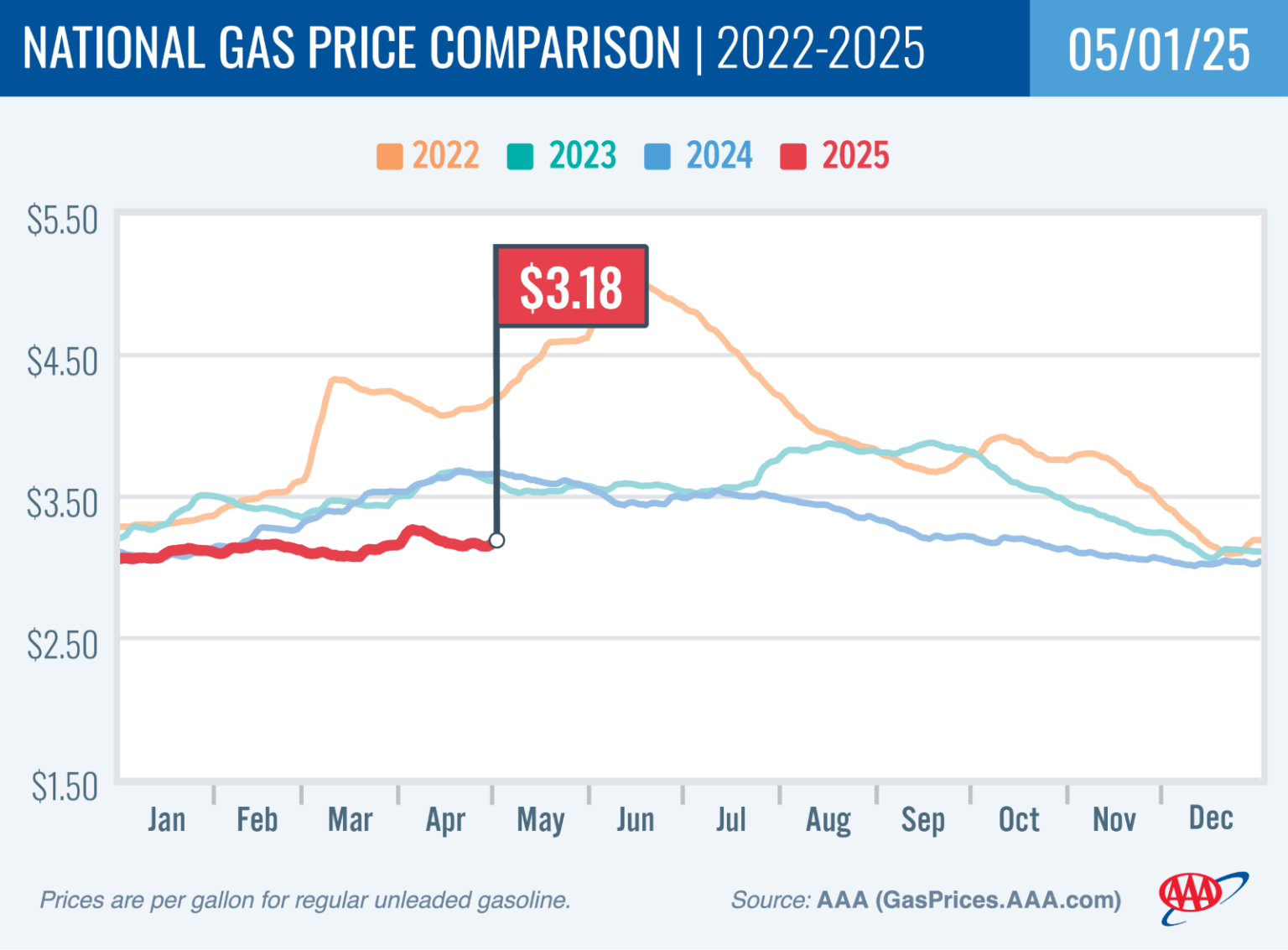
As of May 2025, the national average sits at $3.18 per gallon for regular gas, according to AAA. That’s up from $3.17 in April and $3.02 at the end of 2024. Diesel prices are climbing, too, averaging $3.57 in April, compared to $3.49 in December.
It’s a modest climb, but it’s nowhere near the highs we experienced in 2022 (as shown in this chart).
So which states are getting hit the hardest? According to AAA data, the most expensive states to buy gas in are:
- California ($4.77)
- Hawaii ($4.50)
- Washington ($4.26)
- Oregon ($3.90)
- Nevada ($3.84)
- Alaska ($3.62)
- Illinois ($3.40)
- Pennsylvania ($3.35)
- Idaho ($3.31)
- Utah ($3.31)
On the flip side, these are the 10 cheapest states to buy gas in:
- Mississippi ($2.66)
- Louisiana ($2.73)
- Tennessee ($2.74)
- Alabama ($2.76)
- Texas ($2.76)
- Arkansas ($2.78)
- Oklahoma ($2.80)
- South Carolina ($2.82)
- Kansas ($2.85)
- Missouri ($2.85)
Fluctuating oil prices, post-winter maintenance at U.S. refineries, and uncertainty in global energy markets are all feeding into this uptick in fuel costs.
At the same time, inflation and interest rates are still high, which can add extra pressure if you’re already juggling higher grocery bills and rising debt.

- Up to $400 Bonus Tiered Disclosure
New and existing Checking and Savings members who have not previously enrolled in Direct Deposit with SoFi are eligible to earn a cash bonus of either $50 (with at least $1,000 total Eligible Direct Deposits received within 25 calendar days of your first Eligible Direct Deposit of $1 or more) OR $400 (with at least $5,000 total Eligible Direct Deposits received within 25 calendar days of your first Eligible Direct Deposit of $1 or more). Cash bonus amount will be based on the total amount of Eligible Direct Deposit received within 25 calendar days of your first Eligible Direct Deposit of $1 or more. If you have satisfied the Eligible Direct Deposit requirements but have not received a cash bonus in your Checking account, please contact us at 855-456-7634 with the details of your Eligible Direct Deposit. Direct Deposit Promotion begins on 5/15/2026 and will be available through 12/31/2026. Full terms at sofi.com/banking. SoFi Checking and Savings is offered through SoFi Bank, N.A., Member FDIC. SoFi members with Eligible Direct Deposit can earn 3.30% annual percentage yield (APY) on savings balances (including Vaults) and 0.50% APY on checking balances. There is no minimum Eligible Direct Deposit amount required to qualify for the 3.30% APY for savings (including Vaults). Members without Eligible Direct Deposit will earn 0.80% APY on savings balances (including Vaults) and 0.50% APY on checking balances. Interest rates are variable and subject to change at any time. These rates are current as of 9/23/26. Fees may reduce earnings. Additional information can be found at http://www.sofi.com/legal/
- APY disclosures
Annual percentage yield (APY) is variable and subject to change at any time. Rates are current as of 9/23/26. There is no minimum balance requirement. Fees may reduce earnings. Additional rates and information can be found at https://www.sofi.com/legal/
- Fee Policy
We do not charge any account, service, or maintenance fees for SoFi Checking and Savings. We do charge transaction fees for outgoing wire transfers, Instant Transfers, and global remittance transfers. Our fee policy is subject to change at any time. See the SoFi Bank Fee Sheet for details at sofi.com/legal/banking-fees/.
- Additional FDIC Insurance
SoFi Bank is a member FDIC and does not provide more than $250,000 of FDIC insurance per depositor per legal category of account ownership, as described in the FDIC’s regulations. Any additional FDIC insurance is provided by the SoFi Insured Deposit Program. Deposits may be insured up to $3M through participation in the program. See full terms at SoFi.com/banking/fdic/sidpterms. See list of participating banks at SoFi.com/banking/fdic/participatingbanks.
- ATM Access
We’ve partnered with Allpoint to provide you with ATM access at any of the 55,000+ ATMs within the Allpoint network. You will not be charged a fee when using an in-network ATM, however, third-party fees may be incurred when using out-of-network ATMs. SoFi’s ATM policies are subject to change at our discretion at any time.
- Early Access to Direct Deposit Funds
Early access to direct deposit funds is based on the timing in which we receive notice of impending payment from the Federal Reserve, which is typically up to two days before the scheduled payment date, but may vary.
- Overdraft Coverage
Overdraft Coverage is a feature automatically offered to SoFi Checking and Savings account holders who receive at least $1,000 or more in Eligible Direct Deposits within a rolling 31 calendar day period on a recurring basis. Eligible Direct Deposit is defined on the SoFi Bank Rate Sheet, available at https://www.sofi.com/legal/banking-rate-sheet. Members enrolled in Overdraft Coverage may be covered for up to $50 in negative balances on SoFi Bank debit card purchases only. Overdraft Coverage does not apply to P2P transfers, bill payments, checks, or other non-debit card transactions. Members with a prior history of unpaid negative balances are not eligible for Overdraft Coverage. Eligibility for Overdraft Coverage is determined by SoFi Bank in its sole discretion. Members can check their enrollment status, if eligible, at any time by logging into their account through the SoFi app or on the SoFi website.
- 0.90% Savings APY Boost
Earn up to 4.20% Annual Percentage Yield (APY) on one SoFi Savings account with a 0.90% APY Boost (added to the 3.30% APY as of 9/23/26) for up to 6 months. Open your first SoFi Checking and Savings account and receive eligible direct deposits OR qualifying deposits of $5,000 every 31 days by 12/31/26. Rates are variable, subject to change. Terms apply at sofi.com/banking#4. SoFi Bank, N.A. Member FDIC.
- Earn up to 4.20% APY8
- Limited Time Offer: +0.90% Boost on Savings APY to up to 4.20% for up to 6 months on new accounts. Terms apply.⁸
- Up to 3.30% APY² with eligible direct deposit or $5,000 or more in qualifying deposits during the 31-day evaluation period.
- $0 minimum balance to earn APY
- Earn $50 or $400 when you sign up and set up eligible direct deposit1
- Open Checking & Savings Accounts with 1 Sign Up
- Up to 2-Day-Early Paycheck3
- FDIC Insured up to $250k plus up to $3M in supplemental insurance4

Barclays Tiered Savings Annual Percentage Yields (APYs) are accurate as of 06/24/2026. Rates may change at any time without prior notice, before or after the account is opened. The same rate may apply to multiple Tiers and Tiers may change without notice. APY earned is based on the Tier in which your end of day account balance falls. Please see Barclays Tiered Savings for current Tier and APY information.
- Earn 3.65% APY* with Barclays1 Tiered Savings
- $0 min. balance to earn APY
- No monthly maintenance fees
- Easy direct deposits & online transfers
- Deposits are FDIC Insured
Advertised annual percentage yield (APY) is for new accounts only and is accurate as of June 16, 2026. APY tiers apply to the following balances:
- 4.01% APY on balances of $0.01 – $999.99
- 4.01% APY on balances of $1,000.00 – $49,999.99
- 4.01% APY on balances of $50,000.00 – $499,999.99
- 3.14% APY on balances of $500,000.00 – $999,999.99
- 3.14% APY on balances of $1,000,000.00 & Above
This is a variable-rate account, and APY is subject to change at any time without notice. Limit of one Envision High Yield Savings account per customer. Minimum amount to open is $100, with opening funds subject to a 5-business day hold. Fees may reduce earnings on account.
- Earn up to 4.01% APY
- No monthly maintenance fees
- Open an account with as little as $100
- Open an account in as little as 5 minutes
- Backed by the financial strength of Idaho First Bank
For complete list of account details and fees, see our Personal Account disclosures.
¹ Platinum Savings is a tiered interest rate account. Interest is paid on the entire account balance based on the interest rate and APY in effect that day for the balance tier associated with the end-of-day account balance. APYs-Annual Percentage Yields are accurate as of July 1, 2026: 0.25% APY on balances of $0.01 to $4,999.99; 3.75% APY on balances of $5,000.00 or more. Interest Rates for the Platinum Savings account are variable and may change at any time without notice. The minimum to open a Platinum Savings account is $100.
² Based on comparison to the national average Annual Percentage Yield (APY) on savings accounts as published in the FDIC National Rates and Rate Caps, accurate as of September 21, 2026.
*Platinum Savings APY Boost Promotion Terms and Conditions
This is a limited time offer available to New and Existing customers who meet the Platinum Savings APY Boost promotion criteria.
Accounts enrolled in the Platinum Savings Annual Percentage Yield (APY) Boost promotion will receive a 0.50% APY boost on the Platinum Savings current standard APY tiers for 6 months following the opening of a new account or when an existing Platinum Savings account is enrolled in the promotion. The Platinum Savings APY boost will be applied on account balances up to $9,999,999.00. Account balances above $9,999,999.00 will earn the standard APY. If the standard-published APY should change during the promotion period, the APY boost will move with it, offering an account APY above the standard rate.
The Promotion begins on September 29, 2026, and ends December 15, 2026. Customers enrolled in the promotion prior to the end date will receive the APY boost for the 6-month period outlined in the terms and conditions.
The promotion can end at any time without notice.
New CIT Bank Customers:
This Platinum Savings APY Boost promotion offer is valid for New CIT Bank customers, who, at account opening, do not have a valid CIT Bank User ID (a “New Customer”) or any open CIT Bank accounts provided that the following requirements are met:
-
New customers must open a Platinum Savings account with a valid Promo Code, Boost50. The Platinum Savings APY Boost Promo Code will appear on the online account opening enrollment web page.
-
The Promo Code must be used at the time of account opening. Accounts opened during the program period without the Promo Code are ineligible to receive the APY boost.
-
The enrolled Platinum Savings account must be open to receive the APY boost during the promotional period.
CIT Bank Customers with an account prior to the promotion:
This Platinum Savings APY Boost promotion is valid for a Primary account owner with an existing account with a CIT Bank User ID before the start of the promotion, provided that the following requirements are met:
-
Customers without a Platinum Savings account open prior to the Promotion must open a new Platinum Savings account via the enrollment web page using Promo Code Boost50.
-
Customers with a Platinum Savings account opened prior to the promotion may enroll their current Platinum Savings account into the Platinum Savings Boost promotion via the enrollment web page using Promo Code Boost50.
-
Customers who are not the Primary account owner on a Platinum Savings account may open a new Platinum Savings account as the primary account owner via the enrollment web page using Promo Code Boost50.
Accounts opened or enrolled during the program period without the Promo Code are ineligible to receive the APY boost.
There is a limit of one Platinum Savings APY Boost promotional offer per account and per Primary customer. If multiple Platinum Savings accounts are opened, only one account per primary account owner is eligible.
There is no minimum account balance requirement to participate in the Platinum Savings APY Boost promotion.
Additional Important Terms
The Platinum Savings APY Boost promotion may not be combined with other promotions.
Customers are ineligible to participate in the Platinum Savings APY Boost promotion if:
-
They are earning an APY over the standard rate.
-
They participated in a cash bonus promotion in the past 6 months.
-
Custodial accounts and accounts in the name of a Trust are not eligible.
-
This offer is non-transferable.
The value of Platinum Saving Boost will be reported as interest income on IRS Form 1099-INT for the calendar year in which it was paid. The recipient is responsible for any applicable taxes.
- Earn up to 4.25% APY* with CIT’s Platinum Savings Account
- No account opening or monthly service fees
- Deposit checks online with the CIT Bank mobile app
- FDIC Insured
What’s causing gas prices to rise in 2025?
Gas prices are nudging up again this year, but not because of one single issue. Instead, it’s a mix of global production shifts, trade uncertainty, and slower demand that’s keeping prices unpredictable.
Here’s what’s going on behind the scenes:
OPEC production increases are flooding the market
After holding back supply for much of 2023 and 2024, the Organization of the Petroleum Exporting Countries (OPEC) has started ramping up oil production again in 2025. The group recently announced an accelerated output hike for June, and some members have already been exceeding quotas. While higher output might sound like good news for drivers, the rollout has triggered volatility instead of stability.
Too much supply, too fast, has pushed crude oil prices down. The U.S. Energy Information Administration (EIA) now expects Brent crude to average around $66 per barrel in 2025, down from $81 in 2024. But this seesaw effect is causing oil prices (and by extension, gas prices) to swing more than usual.
Tariffs are adding to global uncertainty
The U.S. and other countries have been adjusting tariffs in response to shifting trade priorities and geopolitical tensions. That includes a temporary suspension of some tariffs and new levies elsewhere. These changes are creating uncertainty for producers and importers, and uncertainty tends to spook energy markets.
The value of the U.S. dollar also plays a role here. Since oil trades globally in U.S. dollars, a weaker dollar can drive up the cost of imported fuel and put more upward pressure on gas prices at home.
Demand is weaker than expected
The global economy isn’t booming, and oil demand is showing it. The EIA recently lowered its forecast for global petroleum demand by about 500,000 barrels per day. In the U.S., economic growth is projected to slow to 1.5% in 2025, down from 2.8% in 2024, which also contributes to softer oil demand.
Lower demand has helped offset some of the upward pressure from supply disruptions. However, it also makes prices more sensitive to even small shifts in policy or output.
U.S. production growth is leveling off
Although the U.S. is still the world’s top oil producer, growth is slowing. The EIA expects U.S. output to rise only slightly in 2025—reaching 13.4 million barrels per day. Some producers are even warning that domestic oil production may have peaked for now due to lower prices and tighter margins.
At the same time, technological advances are making U.S. production more efficient. According to the EIA, the average number of wells completed per location in the Lower 48 states more than doubled from 2014 to 2024. That means producers can bring oil to market faster—but they’re still hesitant to oversupply when prices are this unstable.
Will gas prices keep going up?
It depends. While prices have ticked up slightly from late 2024, the EIA expects retail gas prices to decrease by about 3% in 2025 compared to last year.
That’s largely thanks to falling crude oil prices, which are the main driver of what you pay at the pump. The EIA also expects only a modest increase in gas demand this year, along with higher gasoline imports to make up for reduced refinery output following the closure of a major facility in Houston.
Still, prices could fluctuate. Regional supply constraints, shifting refinery margins, or new tariffs could create temporary bumps throughout the year. But overall, the EIA doesn’t anticipate a repeat of 2022’s price surge.
What could bring prices down:
- Lower global oil prices
- Stable or weakening demand
- Increased EV adoption and fuel efficiency
What could push prices up:
- Summer travel demand
- Tariff changes or supply disruptions
- Refinery closures or reduced U.S. production
Gas prices also vary by region. If you live in California, Washington, or Hawaii, for example, you’re likely paying more than someone in Texas or Georgia due to state taxes, regulations, and local supply chains.
Most people have regular travel patterns and driving needs (e.g., to and from work, regular activities around the area like grocery shopping, and any planned travel). I recommend having a defined budget and tracking your average expenses over time. Gas prices will fluctuate, and it’s not necessarily a concern for most individuals unless you have regular, heavy travel.

What to do when gas costs more than your budget allows
When gas prices rise, it can throw your whole budget out of balance, especially if you commute long distances or drive a vehicle that’s less fuel-efficient. Although gas prices may be out of your control, you can take steps to soften the blow.
Here are some realistic ways to cut gas costs or stretch your budget further:
1. Plan smarter driving days
Instead of making separate trips throughout the week, combine errands into one loop to save time and fuel. Use Google Maps or Apple Maps to plan the most efficient route with multiple stops.
2. Use gas price tracking apps before you fill up
Prices can vary dramatically even within the same neighborhood. Apps like GasBuddy and Upside show real-time prices nearby, and some even offer cashback when you upload a receipt.
3. Ask your employer about commuter perks
Some companies offer pre-tax commuter benefits, mileage reimbursements, or even gas stipends for in-office days. If you’re not sure what’s available, a quick email to HR could be worth it.
4. Don’t skip maintenance
Keeping your tires properly inflated can improve fuel efficiency by up to 3.3%, according to the U.S. Department of Energy. And using the right motor oil and changing air filters regularly can also help stretch your mileage.
5. Switch to grocery chains with fuel rewards
Stores like Kroger, Safeway, and Costco often offer gas discounts for members or frequent shoppers. If you already shop there, you might be missing out on savings just by not scanning your rewards card.
6. Drive more efficiently
Avoid hard braking and fast acceleration. (They burn more fuel.) Try using cruise control on highways and aim to drive during off-peak hours when traffic is lighter and speeds are steadier.
Need gas money before payday?
If your tank is running low and your paycheck is still a few days away, a cash advance app like EarnIn can help cover the gap. You can access part of your earnings early with no mandatory fees, and it’s faster than applying for a loan or overdrafting your account.
If you’re having financial challenges, the most important thing is to budget! If you track and understand where your money is going, you’ll have more control over your situation. This helps you adapt and make changes as needed in case, for example, gas prices go higher and cut into your budget.
FAQ
Are gas prices expected to go down in 2026?
Yes, projections indicate a decline in U.S. gasoline prices by 2026. The EIA forecasts that average retail gasoline prices will decrease by approximately 6% in 2026 compared to 2025. This anticipated drop is attributed to factors such as lower crude oil prices and reduced gasoline consumption due to improvements in vehicle fuel efficiency.
Do electric vehicles help insulate consumers from rising gas prices?
Absolutely. EVs offer a buffer against the volatility of gasoline prices. EV owners typically benefit from more stable and often lower fueling costs, especially when charging at home.
For instance, over the past decade, EV owners charging at home have saved an average of $81 per month compared to those driving gasoline-powered vehicles. This financial predictability not only benefits individual households but also contributes to greater economic stability, as consumer spending constitutes a significant portion of the U.S. GDP.
Why do gas prices vary so much by state?
Gas prices vary by state due to differences in taxes, environmental regulations, and supply infrastructure. States like California impose higher fuel taxes and require special fuel blends, which raise costs at the pump.
Local supply issues, such as refinery capacity or distance from fuel sources, also play a role. Add in market factors like competition and demand, and you get significant differences in gas prices across the country.
About our contributors
-
 Written by Cassidy Horton, MBA
Cassidy Horton is a finance writer passionate about helping people find financial freedom. With an MBA and a bachelor's in public relations, her work has been published more than 1,000 times online.
-
 Edited by Amanda Hankel
Amanda Hankel is a managing editor at LendEDU. She has more than seven years of experience covering various finance-related topics and has worked for more than 15 years overall in writing, editing, and publishing.
-
 Reviewed by Eric Kirste, CFP®
Eric Kirste, CFP®, CIMA®, AIF®, is a founding principal wealth manager for Savvy Wealth. Eric brings more than two decades of wealth management experience working with clients, families, and their businesses, and serving in different leadership capacities.